Showing posts with label Barcelona. Show all posts
Showing posts with label Barcelona. Show all posts
Monday, 7 November 2022


Saturday, 29 October 2022

Glad to announce CritTeam´s artistic intervention at Barcelona Pavilion, with the support of Mies Van Der Rohe Fundación in the Barcelona Loop Festival 2022. We will present a video, a photobook and make three workshops on The Grid, an unprecedented way of seeing the Pavilion. Come and see from the 8th to the 20th November.
Tuesday, 30 June 2020
Even Ugly Buildings have a Photo

I remember a comment by Catalá-Roca, one of the best photographers ever, that he went to visit locations he wanted to photograph before doing so, without a camera, and he saw the photos then. I think I could have gone hundreds of times to this ugly building, the Museum of Natural Science at Barcelona Forum, and I would not have found this picture. It was by chance, in the midst of confinement phase 1 that just bumped into it. I learned from the experience that even the ugliest building have a photo, just have to discover it.
Wednesday, 13 May 2020
Back on the Road
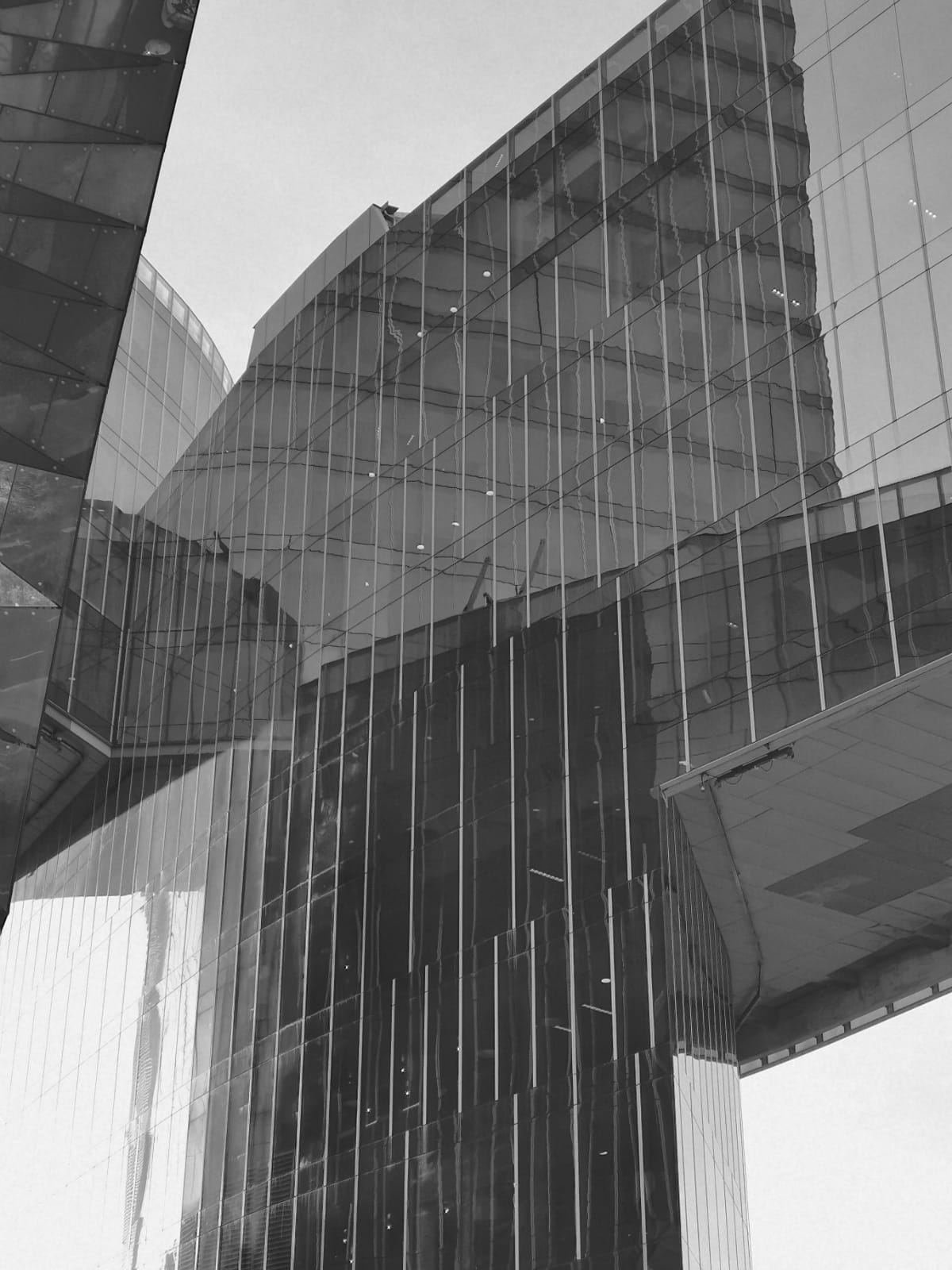
Taking advantage of the allowed scrolls I bumped into this wonderful piece of architecture by Enric Miralles and Benedetta Tagliabue. Art always takes us back to that essential emotion called aesthetic fruition even when we are unaware that we are in front of a work of art. Enjoy it!
Tuesday, 8 November 2011
Dibujo del bueno

Saturday, 15 October 2011
The Thinking of Thom Mayne

Interesting lecture by architect Thom Mayne, at IAAC, Barcelona, yesterday. He talked about the “type of thinking” behind his works.
Through the lecture, he developed his point underlying certain “Non-Cartesian way of thinking” and also “thinking through things and not through words”. He illustrated his approach to thinking by celebrating things that are “always unique, never systematic”. In the case of the entrance to his extraordinary new building in China, the Giant Group Campus, the architect from Connecticut described it as “100% conceptual, completely useless, pure rhetorical”. Even, at a certain point, the 2005 Pritzker Prize resumed his whole life as a devotion to “not doing classical architecture”.
Ultimately, it sounded that Mayne, more than showing his way of thinking, showed the way he intensifies his beautiful forms by hiding the simple and extremely conventional way of thinking that lays behind his works. This slight contradiction, that does not devaluate a bit the immense quality of his work, is interesting for me, as I am working at the moment "How we think" by John Dewey in order to improve how we teach architecture. This contradiction just mentioned is assumed by Mayne himself: He emphasised that the “chassis” of his Cooper Union building in New York, was “incredibly simple”, and that this fact was completely hidden to the user through the concentration of the “encounters of different things” in its extremely sophisticated hall.
Tuesday, 9 November 2010
The Price of Globalization in Architecture
 Some new buildings of Barcelona that do not "construct the city" was the theme of the tertulia. Agbar, Auditori, Gas Natural, Dwellings by Clotet, etc. are isolated buildings that do not pay any attention at all to inmediate public space.
The thing is that those buildings "construct the Metropolis", which is the useful unity to participate in the global scale, as the last two posts of this blog sustain. The public space in the global scale is the media: newspapers, magazines, TV, etc.
Let's hope we have had enough Forums and this sort of mediatic buildings and get back to the kind of architecture that has elevated the quality of life of Barcelona and its citizens so much in the last two decades. Real, material and everyday architecture and luxurious public space is the only way talented people from around the world will come to live here and start new businesses.
Wednesday, 3 November 2010
Do it in Barcelona

The new Metropolitan Strategic Plan has been presented yesterday. The Mayor, J. Hereu, said that it can be among the best global metropolises at the end of next decade. One perceives enough enthusiasm in the street to get there. It is going to be exciting.
Friday, 29 October 2010
Mercat de Mercats
This last days the city centre of Barcelona became a huge market place, "El Mercat de Mercats", a truly market not a virtual one. Lots of food and natural products in the public space. No wonder, the word market and the word square means the same thing in peninsular Spanish as markets began in the main squares of cities like Barcelona. The text and the audio is in Catalan, the beautiful language of Catalunya that has literature and poetry of great quality.
Saturday, 16 October 2010
Public Luxury in Barcelona

Sometimes the simplest things are the most important. Bicing, the almost free service of bicycles in Barcelona is able to change the way citizens use the city. It is not intended to be an entretaintment: it is an alternative mean of public transportation.
Yesterday, at two in the morning, it was fantastic not to take a taxi or a night bus back home. As a friend said: that is a truly luxury.
Thursday, 14 October 2010
The Architecture of Barcelona

Great opportunity for visiting the new and good old buildings of Barcelona.
48HOPENHOUSE BCN is an event that takes place the whole weekend and there are several architectural visits. It is going to take place the 16th and 17th of October, so next weekend. See you there...
Tuesday, 5 October 2010
Mariscal at the Pedrera
 Mariscal is one of those artists that after his death everybody is going to say he was a genius. To have a taste of his talent visit the wonderful exhibition at the Barcelona's Pedrera, Caixa Catalunya. It is going to be opened until January.
Sunday, 3 October 2010
Festa al Cel 2010
Amaizing what technology can do when it is about killing other human beings! Well, it is true that the Airbus 380, at the same hight as the F18, it is remarkable too. All these are part of "Festa al Cel"
Thursday, 30 September 2010
Mèrce Global
Uno de los espectáculos más multitudinarios (1.4000.000 personas inundaron las calles de la Barcelona durante La Mèrce, según El País) fue el concierto de Abrar-ul-Hak, pakistaní que mezcla la música tradicional de su país con el pop. El contraste con esta maravilla de experiencia global lo dieron los supuestos anti-sistema a los tres dias en la Manifestación de la Huelga General. De todas maneras hay que ir acostumbrándose a estos contrastes: han llegado para quedarse.
Sunday, 19 September 2010
Barcelona Beaches


Oriol Bohigas, the chief architect of the urban transformation of Barcelona'92, disagreed on the idea of “fabricating” the beaches of Barcelona at the end of 1980’s.
The thing is that the sand of the beaches of Barcelona are naturally taking away by the sea some kilometres down the coast and deposited at the river Ebro’s Delta. To maintain the beaches as they are right now (well, as a matter of fact they have lost a lot of the sand already) the Municipality has spent this year 400 million €, 750.000 m3 of sand and lots of work. There is an article at El Pais, a video and a link to the Municipality that has information (in Spanish and English).
The effort is good business, anyway: the beaches of Barcelona are the most visited in Spain with 14.000.000 tourists. Just as Simón Bolivar once said, in a total different context, “If nature opposes us, let's fight against it and make it obey us”. By the way, Bolivar (his statue) is staring at the sea in the Barceloneta Beach.
Friday, 17 September 2010
Global Inspiration


An excellent example of a delicate attention to the context while satisfying modern-global requirements is the new building of Pei for the Lombardy Region in Milan (under construction). It is undeniable the benefits of Pei's experience at the Hancock Tower (1976): the new complex is much better integrated to its immediate context.
It could not be a better heir of the Ponti's Pirelli (1958), which is the building where the Lombardy Region is right now, and it is the one that inspired Mitjans' Banco Atlantico (1969) in Barcelona. Certainly, a chain of global inspiration.
Monday, 23 August 2010
Art in the street

At the quarter of Gracia, in Barcelona, they decorate the streets in their anual celebration week. Modrian would have been delighted to walk down this instalation.
Sunday, 25 May 2008
Guernica, forma y cubismo

Me ha llegado esta peli sobre el Guernica que me parece interesante. Es de una estudiante de la Universidad de Georgia que dice que siempre ha estado interesada en el arte y en las TIC. Ha combinado las dos cosas en esta que es su tesis: una recreación tridimensional del Guernica de Picasso. Lo primero que me gustó es que contesta de una manera muy visual el lugar común de la simultaneidad como explicación última de la forma cubista. Lo de la cuarta dimensión cubista (el tiempo) como secreto del cubismo ya lo contestaron argumentalmente los propios protagonistas de las vanguardias, ahora la verosimilitud volumétrica de estas figuras en 3d que originalmente han sido pintadas en dos dimensiones ponen de manifiesto su esencia formal-espacial, y no una simple iconografía resultante de la simple superposición temporal. Esto me recuerda cuando un casi desconocido Mariscal ganó con su Cobi el concurso para la mascota de Barcelona 92. Entonces los incrédulos se frotaban las manos ante el reto de hacerlo tridimensional: el muñeco definitivo es una pieza de diseño excelente. Pasearse por dentro del Guernica y después ir a verlo en la nueva sala que le han preparado en el Reina Sofía es un planazo. La autora es Liena Gieske y la música es de Manuel de Falla. La página web de Liena explica como hizo la peli.
Tuesday, 29 April 2008
La baldosa de Gaudí

Pasear por el Paseo de Gracia es pasear. Entre otros placeres, está el de disfrutar su pavimento. No es facil fotografiar un pavimento, por eso he elegido esta foto de la web que está muy que muy bien. La baldosa diseñada por Gaudí es todo un portento de diseño industrial. Por cierto que en el Colegio de Arquitectos de BCN venden un puzzle con el motivo de las baldosas que nunca he comprado. Cuelgo un extracto de la explicación de Giralt-Miracle sobre el pavimento:
La prodigiosa capacidad gaudiniana de ver las formas y combinarlas se pone de manifiesto una vez más en esta propuesta, que solamente es comprensible cuando se juntan siete piezas hexagonales, ya que cada una sólo muestra un tercio de los símbolos dibujados en un suave bajo relieve, un planteamiento que rompe con la tradición de la baldosa cuadrada que tiene un único motivo ornamental. Otra característica de estas baldosas es que no están pintadas, sino que son de color verde nefrita, lo cual da luminosidad al suelo.
En homenaje al arquitecto, la ciudad de Barcelona ha pavimentado el paseo de Gràcia con baldosas producidas con los moldes originales por la misma empresa que las fabricó a principios del siglo XX.
Daniel Giralt-Miracle
Comisario general del Año Internacional Gaudí
Subscribe to:
Posts (Atom)



 Posts
Posts


