Thursday, 30 October 2008

A lasting crisis


The cuts in education expenses, as a measure against current financial crisis, is a sign that the way out of it is not even near.

The despotism of instrumental rationality is still in charge, I am afraid. In a recent article in
El País Paul Krugman explains the idea of the Homo economicus, "whose preferences can be expressed mathematically". The world’s view that has driven our lives in the West for almost the last two centuries is based in the negation of the internal contradiction of human nature. Orient has taken the lead in that sense.

For avant-garde artists art is the solution of human internal contradictions in a satisfactory way: the three coordinates of reason, desire and feeling (Ozenfant). I am convinced of the necessity of understanding artistic way of thinking as a way of re-funding humanism in the 21st century.

Only through education our mentality will evolve. If we do not learn to respect emotions, we will never have a truly model of human behavior and no reliable economic and political planning would be possible. In the
webpage of Krugman there are lots of his best articles for free.


Wednesday, 22 October 2008

Le Corbusier, a young 71 years old

It is worth listening, first hand, what the greatest architect of last century wanted to tell us when he was 71 years old. The images that illustrate the video are not at the level of the speech, I am afraid. Nevertheless, it is interesting to find out the balance he does of his own huge work at the end of his life. Creating ideas, those intellectual constructions that resist time and questioning, is a hard job specially for a "visual man" like Le Corbusier. The sound recording is from an interview at the BBC in 1959. Here is the link

Sunday, 19 October 2008

Formalism and reflexivity in Economy, not in Architecture

Krugman, by Alan Cordova, Flickr

Georges Soros, adam kesher2000, Flickr

A good thing of current global financial crisis is that it promotes attention to how the world is ruled. Last century John Maynard Keynes said that "little else" than Economy and Political Philosophy does (General Theory, 1936).

It has always been obvious to me that Art and Aesthetics is lacking in this list. Actually, I find surprising that "formalism" and "reflexivity" are terms of great interest in economical debate. Brand new Nobel Prize Paul Krugman and George Soros defend each concept in that arena.

At the end of his book "The Enlightenment´s Wake", John Gray bases his hopes for the future of "western cultures" in the introduction of "some varieties of poetry and mysticism" in modern modes of thinking. Wouldn´t be easier to re-shape our idea of modernity and to include the third aspect of human constituttion Kant discovered in his third Critique: the aesthetic autonomy againt reason and ethics?

Saturday, 4 October 2008

Architecture's Week in Madrid


From 6 to 12 of October dozens of famous buildings will be open to the public, guided by architectural students, lots of conferences, films, visit to the site with the designer, etc. The program has more than 35 pages. It is an incredible opportunity to get closer to one of the best architectures in the world explained first hand by its authors and local critics. Architecture's Week is a real festival.

Thursday, 2 October 2008

Ghosts in Segovia

Cockle-pickers at Morecambe Bay, Lancashire, UK

A car trapped by the tides at Morecambe bay, 400 meters from shore

Ai Qin Lin, who survived the Morecambe bay tragedy, and main character of the film

Ghosts is the way illegal Chinese immigrants and local British workers call each other.
Ghosts is also the name of the documentary shown in Segovia last Sunday at the Hay Festival.

It is the true story of a group of 23 illegal Chinese workers that were killed in Lancashire, UK, in 2004. Nick Broomfield, the Director , said that there are 20 millions slaves in the world right now. He also has created a foundation to collect the half a million dollars the relatives of the killed worker have to pay the lenders. The film is an excellent example of art and politics interacting without contaminating each other: the suspense sequences are one of the best ever shoot.

I first knew about this tragedy few weeks ago while asking Rod Morgan (author of the Oxford Handbook of Criminology) about the exploitation of immigrants in the UK. Do not miss it, it is in DVD.

Monday, 29 September 2008

Global or Western Crisis?


Photo by El Adelantado de Segovia


There is not a better way of coming back to work (and reality) than to plunge into the Hay Festival in Segovia. Global Crisis: is the world economic system out of control? was the event held on Friday.

At the beginning, the moderator Adam Austerfield (LSE) said that people blame them (economists) for the crisis, and that that was unfair. I agree that economists are not the only to blame as almost everybody finds extremely difficult to think about the way we all think. The root of the crisis is exactly there: current western mentality in which we all are involved.

This crisis is consequence of thinking that mathematics, which is at the base of economy, is able to solve human problems stand-alone. On Friday, in Segovia, the ideal of humanity as a balance between rationality, ethics and aesthetics was truly far away: while the public used their chance asking where to put the money, Danny Quah, the expert in economics from the LSE, simply recommended the Golf Countries without the slightest sign of regret.

This crisis will be solved, no doubt. But the risk of not rectifying our mentality is going to be the prevalence of the political version of the Gresham Law John Gray exposed in his False Dawn: bad capitalism is going to expel good one. By the way, Gray thinks that this is not just another crisis but the fall of USA just as the Soviet Union did when the Berlin Wall came down. Here is the article at The Guardian in which he says so few days ago.

Monday, 11 August 2008

21st Century life in Georgian Spaces

Model of the city at the Building of Bath Museum
The Circus, 1754-69, John Wood Senr. and Jnr.

Inside a John Pinch georgian house, 6,60 mts wide aprox.

A special combination of regulations, cultural trends and business strategies are responsible for the impressive urban artifacts in Georgian Bath from 1667 onwards. The curious thing is that inside these buildings live people that still can enjoy some of the eighteenth and nineteenth century most admirable pleasures, such as long and civilized conversations, while most of them are up to date in the latest issues of the arts, technology and politics. This fact demonstrates that it is possible to have the best of every time, that we can vindicate the right not to choose. Modernity and tradition are compatible if we select the essential aspects of both.

Wednesday, 23 July 2008

Bath Spa, Somerset, England

Royal Crescent, photo by David Iliff (click on it to enlarge)


This is going to be the scenario of my summer. Bath is a very special city: all of it has been designed by the same hands and the same eyes. The order in Bath is not just in the space, it extends in many different ways to everyday life. Winston Churchill said in a speech at the Architectural Association in London that "we make buildings and afterwards the buildings make us".

To spend some time in such a beautiful city resets anyone´s soul. In the Abbey of Bath was crowned the first king of England 1035 years ago. How on earth do I remember such a date so precisely? Easy: I happened to be there on the 1000 anniversary. That is the purpose of celebrations isn't it?, to fix things in your mind and in your spirit.

Good summer holidays and see you in September.


Wednesday, 16 July 2008

The Oxford Conference: ¿ethics vs art?


photo: Tim Waters, Flickr


The conference on architectural education in Oxford has good intentions, but that is not enough I am afraid. The idea is literally to save the planet form artist-architects in the name of sustainability. The answer to this rather old good will is, again, in the historical avant-garde: “they claim to defend nature while poets respect it much more than gardeners”, used to say avant-garde artists at the beginning of the 20th century in defense of artistic abstraction. It is evident that there is still the need of explaining the precise artistic nature of architecture in contemporary times. A good start would be not to oppose ethics and art: that is pre-modern. Referring to Siza or Zumthor when talking about contemporary architecture (instead of Ghery and Starck) could also contribute to clarify what I suppose is our common enemy: spectacle and commoditization in architecture.

It is a pity that the conference does not take place at the St. Catherine´s College, the wonderful master piece by Arnee Jacobsen located precisely in Oxford. That work of architecture is capable of defending contemporary art all alone. By the way, the moralist stand of this 2008 Oxford Conference reminds me of the struggle against Jacobsen´s project in the oxfordian press of the time when the building was being constructed. Fortunately, some English schools have responded to the spirit of the conference: Brett Steele (Architectural Association) and Iain Borden (Bartlett) have struck back.

Read this document on Scribd: press release july08OXFORD CONFERENCE

Monday, 14 July 2008

Arquitecturas del Exilio Español


The Comité International des Critiques d´Architecture, CICA, has given the CICA Award 2008 to the book Arquitecturas Desplazadas, Arquitecturas del Exilio Español by Henry Vicente, at the UIA Congress in Turin, Italy.

The book is the catalog of an exhibition held on May 2007 in Madrid, with the support of the Spanish Gobernment, and is part of the PhD research of Vicente. Besides his, there are also texts of Lorenzo González Casas, Luisa Bulnes Álvarez, Fernando Álvarez Prozorovich, and Juan Ignacio del Cueto Ruiz-Funes.

In the round table in the MOPU exhibition it was suggested to include those exiles who were not architects but did teach architects. I included then, and I do now, those who coached or influenced me in Venezuela: Enrique Domingo Rosich, Máximo Jimenez Labrador, José María Almiñana, Manuel Perez Vila, Pedro Viloria, Pedro Grases, Enrique Martín de Villodres, Pedro Silbert and Luis Reus Díaz. The Jury of the CICA Awards 2008 had Joseph Rykwert as president.


Read this document on Scribd: Press Release 3 Winners List 30-06-08

Saturday, 12 July 2008

The "occult powers of mobile phones" and the New Modern


What to read in the summer...? How about Black Mass by John Gray and Critical Modernism by Charles Jenks.

Why they should be read?. Well, I recomend them for two reasons. First, because it is not so easy to find intense reflexions on the present, on what is happening in our lives. Second, because Gray is considered "the most important philosopher alive" and he is the one Charles Jenks chose to back his new agenda at the Royal Academy in London last autumn. I find fascinating the intellectual moves from the New Right to New Labor (Gray) and from Post-modernism to Critical Modernism (Jenks). There is not better medicine for kantian idealists that big doses of post-ideological thinking: have a nice summer.

Friday, 11 July 2008

Light and movement

Digital animation in architecture is misleading: it "explains" so realistically a building that architectural values normally vanish automatically. The experience of architecture is synthetic and to animate an architectural representation requires truly creative skills. As it is an aesthetic fruition what is at stake an animation of architecture requires an artistic approach to give an account of it.


Just by chance, I am afraid, the video below has this value. It is by Henrik Wann Jensen (Stanford University) and Stephen Duck (MIT) and is intended to show the differences between Ray Tracing and Photon Mapping (the latter invented by Wann). The thing is that the model chosen is a unbuilt work of Mies van der Rohe and the video shows, besides the features of the computational tool, the living spirit of a non existing architectural masterpiece: light.


Wednesday, 9 July 2008

Architecture, politics and sex

Liebeskind skyscraper Milan, (Archinet)

The politicy of “putting cities in the map” through iconic buildings (gherkins) has finally bumped into an awkward subject for urbanism and architecture: sex. The problem starts when politicians think of architecture as a source of meanings (individual and collective), and not as a chance of constructing artistically.

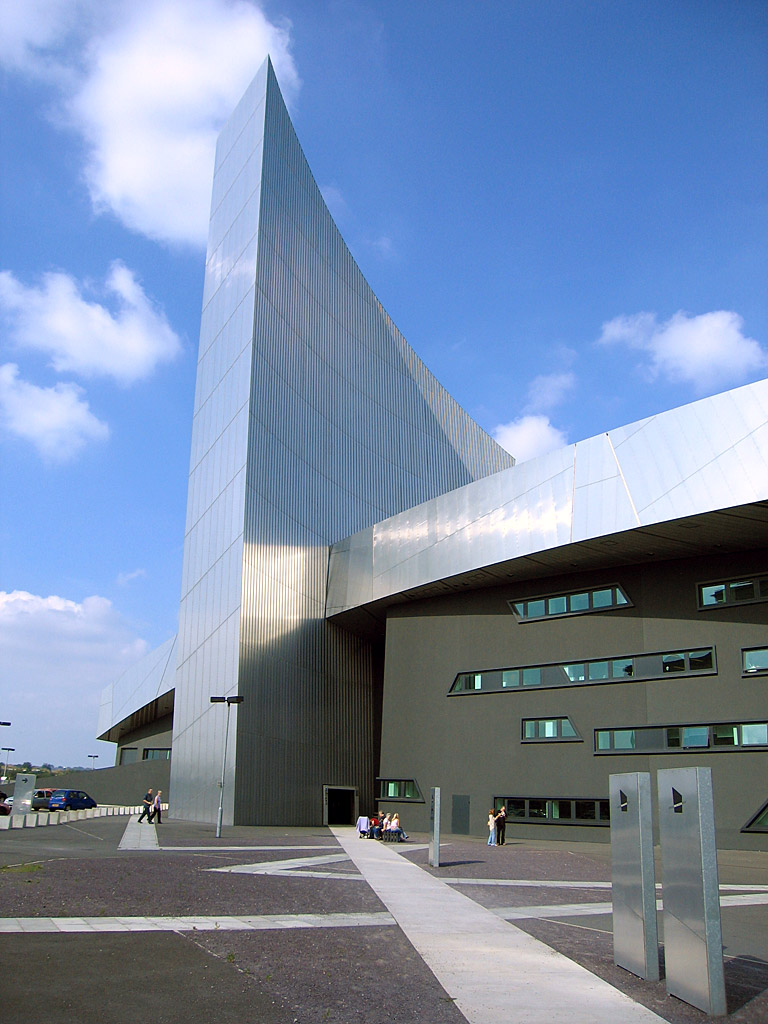
The polemic on the “impotent” (Berlusconi) skyscraper of Daniel Liebeskind in Milan is the result of forcing architecture to represent almost literally what the public should see: “the meaning of the Holocaust” in the Jewish Museum in Berlin, the “globe shattered into fragments” in the Imperial War Museum in Manchester, an “open book” in the Bar-Ilan University in Israel and “the Orion Constellation” in the London Metropolitan University.

The paradox is that the impulse of being represented by buildings is precisely what keeps architecture alive. Alejandro de la Sota was a expert in doing architecture while people only asked him to do a house, a school or a Council Hall. Konrad Fiedler used to say that "the form, which is the content, does not represent but itself": every architect should remember that when taking the briefing form politicians. This link opens the article "Not manly enough" Berlusconi´s verdict on Libeskind work, by Arifa Akbar in The Independent.

Sunday, 6 July 2008

Visuality in the Digital era

Net.art is to our era what Cubism and Purism were to industrialization. Back in the beginnings of the 20th century people were disguised by the formal discoveries of the historical avant-garde, because they challenged what art had been until then. Internet has changed our world because it has changed our relation with it, that is undeniable. Art is still about making visible that part of the world that only makes sense when is seen.

Well, again, people fear to be teased by digital art and new media when they visit the exposition "Souls & Machines" at the Reina Sofia Museum in Madrid. The combination of "art, technology, mystery, emotion and beauty" makes this exhibition, together with Javier Riera´s "Noche Áurea", worth visiting. Visuality is alive, long life to art. Have a look (which means enjoy in this context) to the work of Sachiko Kodama on ferrofluids and electromagnetic camps: it is a film, just a film, that shows what happens in front of your eyes when you are before the work at the museum.

Plastic, plasticity and architecture


Through Archinet I got the news: Zaha on shoes. From an strict formalistic point of view, the versatility of a form is inversely proportional to its artisticity: in a world of commodities pure form serves specially as a “mute critique” to that state of the art (Adorno). From this point of view, to be really artistic, a shoe-work-of-art should be a commercial failure (uuh?). On the other hand, the incursion of deconstruction in industrial design could be interpreted as a return, as almost all it has produced in architecture are but beautiful objects out of scale, out of the scale of the city, out of the scale of the inhabitants, out of scale of the use.

The venture between Melissa and Zaha Hadid is mixing plasticity and plastic with a very profitable horizon, no doubt. The video is interesting as it shows that in the end it is digital technology what makes this new trend of sculpture possible. As a matter of fact, deconstruction could be re-named as de-scaling. By the way, Patxi Mangado is going to be next Eero Saarinen Visiting Professor at Yale, the position Hadid has just left, and he has said they are opposite as architects (here is the article in Spanish)


Wednesday, 2 July 2008

PhD Summer Course Bergamo 2008

The IE School of Architecture has been invited to the PhD Summer Course of the Politecnico di Milano in Bergamo. The Dean and the Associate Dean of the faculty, Professor Javier Quintana de Uña and José María de Churtichaga, along with professors Miguel Jaime and Eugenia López Reus, will be part of the jury of the final review. This year the theme is the High-rise Buildings and Landscape. The course will take place from the 7th to 19th of July 2008.

Read this document on Scribd: Dr PAU